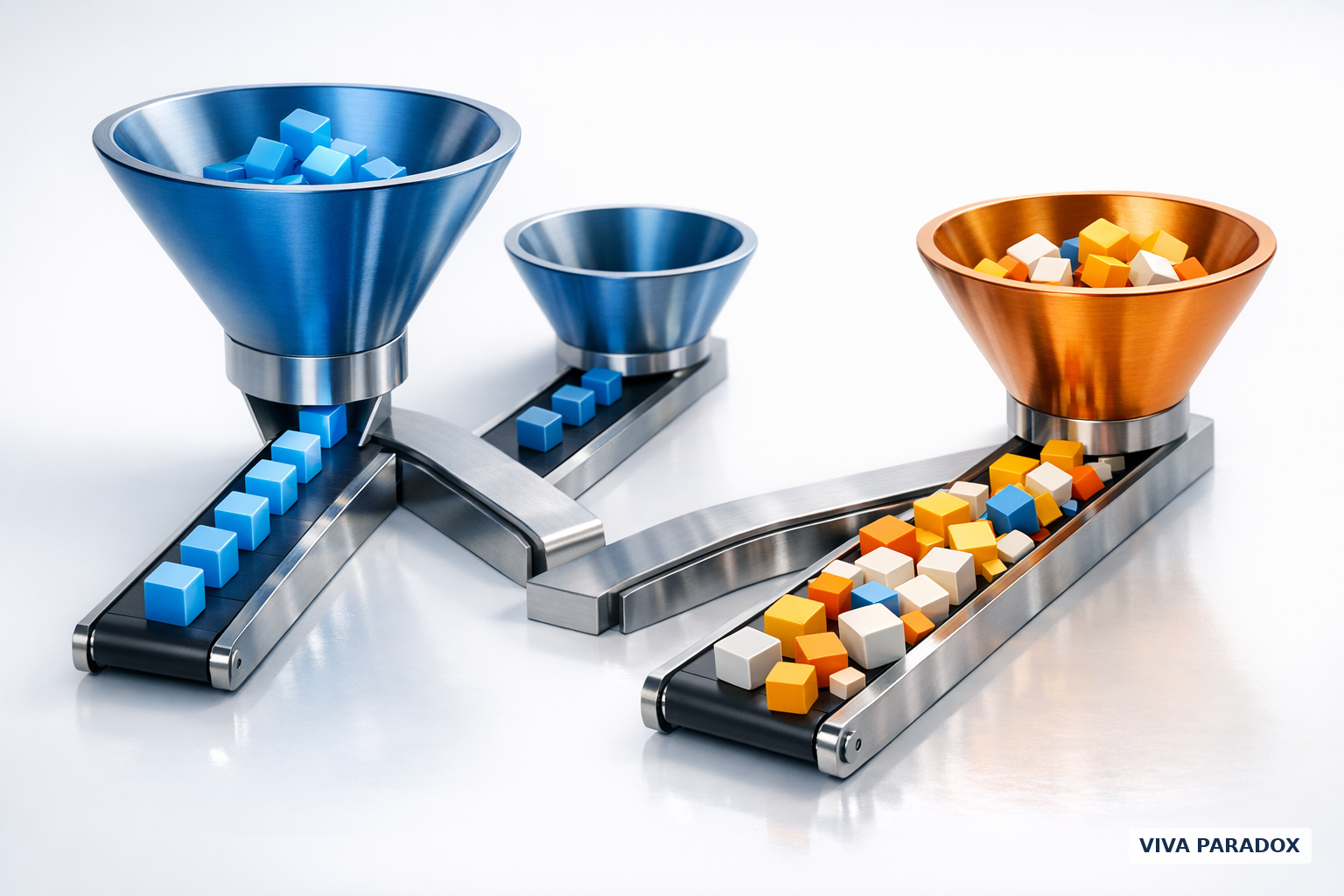
Data drift is a change in the statistical properties of the input data a machine learning model sees in production compared with the data it was trained or validated on. It means the model is operating on data that no longer looks like its original baseline.
For ML engineers, data scientists, analytics engineers, and product teams responsible for deployed models, the important point is that data drift is a monitoring signal. It can indicate that customers, products, markets, sensors, or data pipelines have changed. It does not, by itself, prove that the model is wrong or that accuracy has fallen.
Why data drift matters
Machine learning models usually learn patterns from a historical dataset. During development, teams often validate a model on held-out data that is assumed to resemble future production data. That assumption can weaken over time.
Data drift matters because it can:
- Reduce confidence in predictions when current inputs differ from the training baseline.
- Reveal operational changes, such as a new marketing channel, new app release, or altered data pipeline.
- Signal that model-quality checks should be prioritized once labels or outcomes become available.
- Create business risk if model decisions are used in pricing, routing, fraud review, credit workflows, inventory planning, or other production processes.
Cloud ML platforms treat production monitoring as a separate operational concern for this reason. For example, the Amazon SageMaker Model Monitor documentation describes monitoring deployed models for changes in data and model quality. Microsoft similarly discusses production monitoring and performance checks in its Azure Machine Learning model performance monitoring documentation. These sources support the practical distinction: teams can monitor whether inputs are changing, and they should also validate model performance when appropriate evidence is available.
Data drift is not the same as model failure
A common mistake is to treat every drift alert as proof that the model has degraded. That is too strong.
Data drift means the input distribution has changed. Model failure means the model is producing worse predictions according to a relevant performance measure, such as accuracy, precision, recall, calibration, error rate, or a business outcome metric. These are related, but they are not identical.
A model can experience data drift without immediate measurable performance loss. That can happen when:
- The changed feature has little influence on the model.
- Labels are delayed, so performance cannot yet be measured.
- The new input range is different but still handled well by the model.
- The change is expected seasonality rather than an unexpected shift.
The reverse can also occur: model quality can degrade even when broad input distributions look stable, especially if the relationship between inputs and outcomes has changed.
The right interpretation is: data drift should trigger investigation, not automatic retraining.
Data drift vs. concept drift vs. label drift
These terms are often used together, but they describe different problems.
| Term | What changes | Example | What to check |
|---|---|---|---|
| Data drift | Input features in production differ from the training or validation baseline | A model trained on one customer mix now receives applications from a new acquisition channel | Feature distributions, missing values, segments, pipeline changes |
| Concept drift | The relationship between inputs and the target outcome changes | The same customer profile has a different risk level after a market shift | Model performance, calibration, error patterns, labels when available |
| Label drift | The distribution of the target outcome changes | The overall rate of a target event rises or falls | Outcome distribution, class balance, business conditions |
| Model-quality degradation | Measured predictive performance gets worse | Recall falls after outcomes arrive | Performance metrics, error analysis, validation on recent data |
| Ordinary seasonality | Predictable recurring changes | Holiday traffic changes buying behavior every year | Seasonal baselines, expected windows, business calendar context |
Seasonality can look like drift if the baseline does not account for it. A retail demand model, for example, may see different inputs during the holiday season. That change may be expected rather than a reason to retrain immediately.
Common causes of data drift
Data drift can come from real-world changes or from technical issues. Common causes include:
- Changing user behavior: Customers use the product differently over time.
- New acquisition channels: A marketing campaign or partner sends a different population of users.
- Product changes: A redesigned checkout flow, onboarding process, or mobile app changes what data is collected.
- Economic shifts: Interest rates, labor markets, inflation, or regional conditions affect user attributes and behavior.
- Population changes: The served population becomes older, younger, more urban, more rural, or otherwise different from the training sample.
- Sensor changes: Hardware, firmware, or device calibration changes the values collected by an IoT or monitoring system.
- Data pipeline bugs: A schema change, unit conversion error, missing join, or logging bug changes feature values without a real-world population shift.
- Policy or eligibility changes: Business rules alter which records reach the model.
The response depends on the cause. A real market shift may require model review or retraining. A logging bug may require a rollback or pipeline fix, not a new model.
How teams detect data drift
Most drift detection starts by comparing production data with a baseline. The baseline is usually the training dataset, validation dataset, or a stable historical production window.
A practical monitoring setup typically includes:
- Define the baseline. Choose the data window that represents the model's expected operating conditions.
- Monitor key features. Track distributions, missing rates, ranges, categories, and outliers for inputs used by the model.
- Segment the analysis. Check drift by region, customer type, device, app version, acquisition channel, or other operationally meaningful groups.
- Compare production windows. Evaluate daily, weekly, or rolling windows rather than relying on one isolated batch.
- Use statistical or distance-based checks. Teams often use statistical tests, distance metrics, or threshold-based monitoring to flag meaningful differences.
- Pair data checks with outcome checks. When labels are available, evaluate model-quality and business metrics alongside drift.
The last step is essential. Monitoring tells you that something changed. Performance validation tells you whether the change appears to matter for prediction quality. The AWS and Azure documentation cited above both support the broader practice of production model monitoring, including watching data and model quality rather than treating a drift signal as a final diagnosis.
Worked example: a hypothetical credit risk model drift alert
The following is an illustrative example with invented numbers. It is not an observed result from a real credit system and is not legal or compliance advice.
Suppose a credit risk model was trained and validated on applicants with these baseline feature properties:
- Median applicant income: $72,000
- Missing employment length: 10% of records
During a recent production week, monitoring reports:
- Median applicant income: $54,000
- Missing employment length: 38% of records
Step 1: Calculate the visible change
From the fictional inputs:
- Median income is down by $18,000, from $72,000 to $54,000.
- That is a 25% decrease relative to the baseline median.
- Missing employment length is up by 28 percentage points, from 10% to 38%.
These calculations do not prove the model is less accurate. They do show that the production inputs differ materially from the baseline for two business-relevant features.
Step 2: Check whether the change is real or technical
Before retraining, inspect the data path:
- Did a new application form make employment length optional?
- Did a mobile app update stop sending the field for some users?
- Did a new marketing channel begin sending a different applicant population?
- Did an upstream service change income formatting, units, or default values?
- Is the shift concentrated in one state, device type, partner, or product?
If the missing employment length is mostly from one app version, the likely issue may be logging or collection. If the change appears across channels and regions, a real population shift becomes more plausible.
Step 3: Relate the drift to model importance and outcomes
If income and employment length are important model inputs, this alert deserves faster investigation than drift in a low-impact field. If labels are delayed, the team may not yet know whether approval outcomes, default outcomes, or calibration have changed. That does not mean performance will remain unknown forever; it means model-quality validation may become possible only after outcomes arrive.
Reference answer
A reasonable decision is to open a high-priority investigation, segment the drift, verify the pipeline, and monitor early business indicators. Do not automatically retrain on this alert alone. If the drift persists across multiple windows and later coincides with worse model-quality or business metrics, then compare a retrained or recalibrated candidate against the current model before changing production behavior.
Boundary case
If the model does not use income or employment length, or if the shift is caused by a known temporary campaign with no degradation in downstream metrics, the response may be continued monitoring rather than retraining. The correct action depends on persistence, feature importance, data quality, and performance evidence.
A practical decision rule
Use this rule of thumb: investigate when drift is persistent, affects important features, and coincides with business-metric or model-quality changes.
More specifically, prioritize action when several of these conditions are true:
- The drift appears across multiple production windows, not just one small batch.
- The shifted features are used by the model and have meaningful influence.
- The shift is concentrated in a segment that matters operationally, such as a product line, region, device type, or protected-adjacent group.
- Missing values, out-of-range values, or category changes suggest a data-quality issue.
- Business metrics, user behavior, or model-quality metrics move at the same time.
- The team can rule out an expected seasonal pattern.
Avoid retraining automatically on drift alone. Retraining on corrupted data or on a temporary anomaly can make a system worse. Confirm the likely cause, build a candidate model or calibration change if needed, and validate it against recent and representative data before deployment.
Realistic failure case: drift caused by logging, not the market
Imagine a mobile app update changes how income is submitted. Before the update, the app sends annual income. After the update, one screen sends monthly income for some users while the feature pipeline still interprets the value as annual income.
A drift monitor may flag a sharp drop in income values. At first glance, that could look like a major change in applicant population. But the real cause is a unit mismatch introduced by a logging or schema change.
In that case, retraining would be the wrong first response. The team should fix the data collection or transformation issue, backfill or quarantine affected records if appropriate, and only then reassess whether real drift remains. This is why pipeline checks should be part of every drift investigation.
What to do after detecting data drift
After a drift alert, choose the response based on evidence:
- Inspect the pipeline. Check schema changes, units, missing values, joins, default values, and logging releases.
- Segment the drift. Identify whether the change is global or isolated to a channel, region, app version, customer group, or product.
- Review feature relevance. Prioritize drift in features the model actually uses and that influence predictions.
- Compare with business metrics. Look for changes in conversion, fraud review rates, complaints, approvals, manual overrides, or other relevant operational measures.
- Wait for labels when needed. If outcomes are delayed, mark the window for follow-up evaluation once labels arrive.
- Adjust monitoring if the change is expected. Seasonal patterns or planned product launches may require updated baselines or segment-specific thresholds.
- Recalibrate or retrain only when justified. If evidence shows the model no longer performs adequately, test a candidate update before deployment.
- Roll back data changes when appropriate. If drift comes from a bad release or pipeline error, fix the data path rather than changing the model.
This workflow keeps the team from ignoring drift while also avoiding unnecessary model churn.
Tools and monitoring platforms
Many teams implement drift monitoring with internal dashboards, data quality checks, feature stores, or model monitoring platforms. Cloud services can also help. Amazon SageMaker Model Monitor supports monitoring deployed models for changes in data and model quality in production workflows, according to the AWS documentation. Azure Machine Learning documentation describes production monitoring and model performance checks, supporting the practice of interpreting input changes alongside performance evidence in Azure ML monitoring workflows.
These tools can surface alerts, but they do not remove the need for judgment. A drift score or threshold breach is a prompt to investigate cause, scope, and impact.
Key takeaway
Data drift in machine learning is a change in production input data compared with the model's training or validation baseline. It matters because deployed models operate in changing environments, and those changes can affect trust, reliability, and business outcomes.
But drift is not the same as proof of model failure. Treat it as an early warning signal. Investigate the pipeline, segment the change, evaluate important features, and connect the alert to model-quality or business metrics when evidence is available. Retrain only after confirming the cause and validating that a candidate model performs better for the current operating environment.